The push out is the rule that separates players who learned 9-ball properly from players who picked it up at the bar.
Most players have heard of it. Far fewer know exactly when it's allowed and what it changes, and fewer still use it well. Here's the rule, checked against the official rulebooks, and then how I'd teach you to play it.
What the push out is
A push out is a one-off shot, straight after the break, where two of the normal 9-ball requirements are switched off.
On a normal shot, the cue ball must hit the lowest-numbered ball first, and after that contact a ball has to reach a cushion or drop. Those are the two fouls I covered in the 9-ball scratch and foul rules. On a push out, neither applies. You can roll the cue ball anywhere: hit nothing, hit a different ball, stop it in the middle of the table.
The price: your opponent then decides who plays the next shot.
When you can play it
Only on the second shot of the rack, the first shot after the break. Under WPA rules, and under CSI rules (the ones BCA leagues play), it's available only if there was no foul on the break.
So it isn't automatically the incoming player's shot. If the breaker makes a ball and stays at the table, the breaker can push. If nothing drops, the incoming player can. The option comes once, and then it's gone for the rack.
You must announce it before you shoot. WPA rules say you make your intention known to the referee. CSI rules say you tell your opponent and they must acknowledge it. If you don't announce it, it's a normal shot, and if you miss the 1 it's a normal foul.
There's one more case if you play under the WPA three-ball break rule, which applies at WPA ranking events. If the break is legal but fewer than three balls are pocketed or cross the head string, the incoming player can take the table as it is, but then they can't push. If they hand it back, the breaker may push out instead.
What changes, and what doesn't
Only two things are switched off: the lowest-ball-first rule and the rail-after-contact rule. Everything else still counts.
Scratch on a push out and it's a foul: ball in hand to your opponent. Knock the cue ball off the table, double hit, touch a ball, all still fouls. The push out is a free placement shot, not a free shot.
Balls that drop on a push out don't keep you at the table. Under WPA and CSI rules, any ball other than the 9 stays down. If the 9 goes in, it's spotted, and it doesn't win you the rack.
Your opponent's choice
After a legal push out, your opponent has two options. They can take the table as it lies and shoot, or they can hand it back and make you shoot from the position you just created.
Whoever ends up shooting then plays under the normal rules again. The 1 must be hit first, a ball must reach a rail, and a foul is ball in hand.
This is what makes the push out a real decision rather than a free escape. You're not choosing a position for yourself. You're choosing a position for whichever one of you your opponent decides should play it.
When to push, and where to leave it
Push when the break leaves you with nothing worth shooting. You're hooked, or the 1 is only reachable with a shot you'd make one time in five, or the safe you'd have to play is likely to leave something.
If you have a reasonable shot at the 1, take it. A push out gives your opponent the decision, and that's a high price for a position you could have played yourself.
When you do push, the aim is a shot that sits right on the edge. Not easy, or they'll take it and run out. Not impossible, or they'll hand it straight back and you're stuck with it. What you want is a shot that suits you and doesn't suit them.
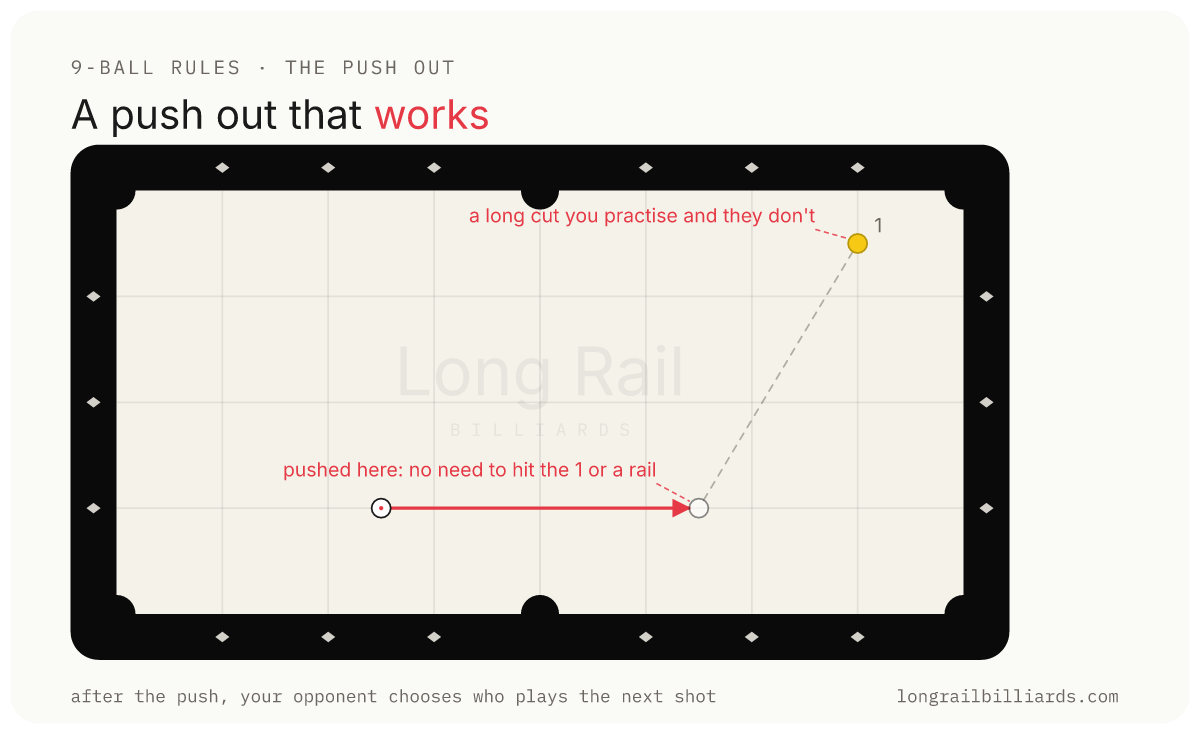
In practice that means pushing to a shot you've practised and they probably haven't: a long cut you make often, a kick you know well, a jump shot if you carry a jump cue and they don't.
Two habits that cost players:
Pushing to a safety you can't play. If they hand it back, you must play it. Leaving yourself a delicate safe that you'd only get right half the time is a bad push.
Pushing too far. The further the cue ball travels, the less exact the position. A short, controlled push lands where you meant it to. A long roll across the table is a guess, and the cue ball control you rely on everywhere else matters just as much here.
How to answer a push
When your opponent pushes, ask one question: who is this shot better for?
If you'd make it more often than they would, take it. If it's the kind of shot they've clearly picked because they like it, hand it back, even if you fancy it a little. And if both of you would struggle, think about what a failure costs. If the shot is a kick where missing the 1 altogether is a foul, whoever plays it is risking ball in hand. Hand that risk to the player more likely to get it wrong.
Don't let pride decide. Handing a push back isn't ducking. It's the whole point of the rule.
Leagues that don't use it
The push out is part of WPA rules and CSI rules, so you'll meet it in BCA leagues and most tournaments.
The APA is the big exception. Its Official Team Manual says push outs are not allowed in APA handicapped play. Only APA Masters divisions, which aren't handicapped, use it, and there any ball pocketed on a push out is spotted. If you play both, the full list of differences is in APA vs BCA 9-ball rules.
Before any event, ask which rules apply. It takes ten seconds and saves the argument.
The skill under the rule
The push out looks like a rules question, but it's a self-knowledge question. To push well you need an honest answer to "which shots do I actually make?" The same honesty decides how you win 9-ball more broadly: play the shots your game can deliver, not the ones you wish it could.
Common questions
Can you push out at any time in 9-ball?
No. The push out is only allowed on the first shot after the break, and only if the break was not a foul. Once that shot has been played, the option is gone for the rest of the rack.
Can the breaker push out?
Yes, if the breaker pockets a ball on a legal break and is still at the table, the breaker can play the push out. If nothing drops on the break, the incoming player has the option instead.
Is it a foul to scratch on a push out?
Yes. A push out only suspends the lowest-ball-first and rail-after-contact rules. A scratch, a ball off the table or any other foul still gives your opponent ball in hand.
What happens if the 9 goes in on a push out?
It doesn't win the rack. Under WPA and CSI rules the 9 is spotted, and any other ball pocketed on the push out stays down.
Does the APA use the push out?
Not in its handicapped divisions. The APA Official Team Manual says push outs are not allowed in APA handicapped competition, and only its non-handicapped Masters divisions use them.
More on 9-ball
- How to play 9-ball: the full game, from the rack to the win
- 9-ball break rules: what makes a break legal, and when you get to push
- The three-foul rule in 9-ball: the rule that makes a bad push expensive
- How to win at 9-ball: when to push, when to play safe, when to attack
Knowing the rules wins arguments. Knowing your own game wins racks. Find out what's costing you racks.
Sources
- WPA Rules of Play, effective 15 September 2025: rules 3.2, 3.3, 5.4, 5.5 and 5.6.
- WPA Playing Regulations, effective 15 September 2025: Regulation 16, the three-ball break rule.
- Official Rules of CueSports International, used by the BCAPL, effective 1 June 2023: rule 3-4.
- APA Official Team Manual, 9-Ball game rules, After the Break.
A 12-question read of your stance, stroke, cue ball and head. You'll find out which of the eight player types you are, and where the real bottleneck in your game is. Free, no signup.
Take the player read