You break, a ball drops, and then you look up and the cue ball is on the far rail, tied up behind two balls, or sitting in a pocket. You had the table and you never got to play it.
That isn't bad luck, and it isn't just you. Of 2,838 players who completed our full assessment, 28% say the cue ball rarely or never ends up where they wanted after the break. It's the single most common problem in the whole data set, more common than any stroke fault, any safety weakness or any pressure problem. You can see the full data study here.
The good news: cue ball control on the break is one of the most trainable skills in pool. It responds fast to the right practice, because most of what goes wrong is a handful of simple, fixable things.
What the data shows
The break is where self-belief and results part company most clearly. These answers are self-reported, so they're what players tell us about their own break.
Three numbers stand out.
Only 26% usually or always get the cue ball where they wanted. Three players in four are, at best, guessing.
High confidence doesn't mean control. Of the 908 players who rate their own break 8 out of 10 or higher, 52% say the cue ball lands where they wanted only sometimes or less. They're judging their break by the spread and the noise, not by where the white finishes.
It improves with experience, but slowly. Half of first-year players (50%) say the cue ball rarely or never goes where they want after the break. After 15 or more years of play it's still 22%, more than one in five.
So if your break is a lottery, you're in a big group. You don't have to stay there.
Why it happens
When I watch a player whose cue ball flies around on the break, I almost always see one of four things.
They hit the head ball thin
The cue ball goes where the energy sends it. On a full, square hit on the head ball, most of the cue ball's energy goes into the rack and the white stops close to where it made contact. On a hit that's even slightly off-centre, the energy splits: part goes into the pack, part sends the cue ball spinning off sideways toward a rail, and from there it can go anywhere.
A thin hit is the number one reason cue balls end up on the side rail or in a corner pocket after the break. And because the break is so fast, you rarely see it. You just see the result.
They break harder than they can control
Every club has a player who breaks as hard as humanly possible and then wonders why the cue ball is on the floor. Power you can't aim isn't power. The harder you hit, the more any small error at the tip turns into a big error on the table. A break at 75% of your maximum that hits the head ball square will move the pack and leave the white mid-table. A break at 100% that clips the head ball thin will do neither.
Their stroke changes on the break
This is the one players don't expect. The break is your normal stroke at maximum stress. If your cue comes across the line a little at normal pace, it comes across a lot at break pace. If your grip tightens, if you lift up before the cue has finished, if your back hand swings out: every one of those shows up loudest on the break. I covered this in more detail in aim or stroke, and the same test applies here.
They never decide where the cue ball should finish
Most players break with one goal: smash the rack. They have no target for the white at all, so there's nothing to measure and nothing to improve. If you don't know where the cue ball was supposed to go, you can't tell whether a break was good or lucky.
How to fix it
Work on these in order. Each one makes the next easier.
1. Set a target zone for the cue ball. For nearly every rack game, the target is the middle of the table, roughly the middle quarter between the side pockets. From there you can reach most of the table, and it keeps the cue ball away from the rails and pockets where scratches and tie-ups happen.
2. Hit the head ball as full as you possibly can. Before you think about pace, think about contact. Aim the centre of the cue ball at the centre of the head ball. Strike the cue ball very slightly below centre, so it arrives at the rack without much forward roll. With a square hit and little roll, the white stops or sits back a little after contact. That's what you want.
3. Find your controllable speed. Start at about half pace and break five racks. If the cue ball finishes near the middle on most of them, go up a notch. Keep going until control starts to slip, then come back one step. That's your break speed for now. It will rise as your stroke gets straighter.
4. Choose your cue ball position and keep it. Where you break from depends on the game, and I've covered the 9-ball specifics in how to break in 9-ball. The general rule: pick one spot, break from it every time during practice, and only change it once you're consistent. Moving the cue ball every rack means you never learn what that position does.
5. Stay down. Hold your finish for a second after contact, the way you would on a normal shot. Players who jump up on the break almost always lift the cue on the way through, and the cue ball goes with it.
The drill: break park drill
This is the drill I give in the Long Rail Report for break control. It's simple to set up and the score tells you the truth.
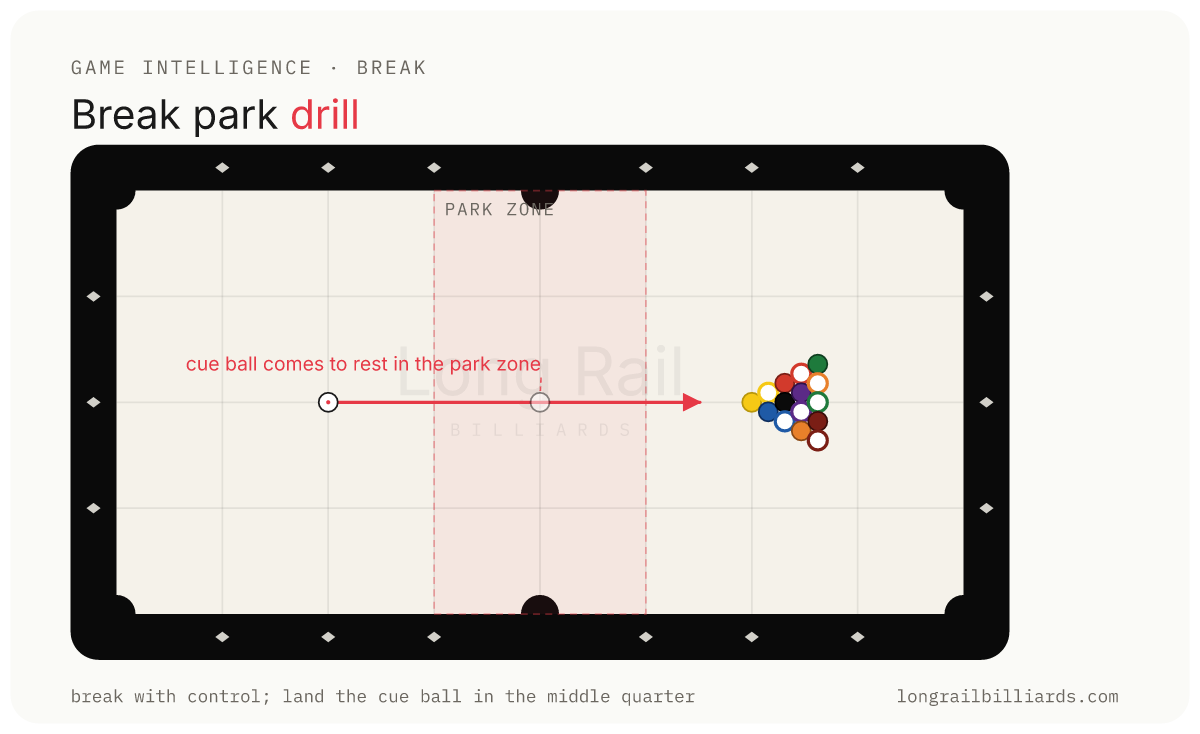
Setup: a standard rack for the game you play most (8-ball or 9-ball). Mark a "park zone" for the cue ball: the middle quarter of the table, roughly between the side pockets. Two pieces of chalk on the rails at each end of the zone are enough.
How: break at a controlled, medium-firm pace. Score each break:
- Ball pocketed and cue ball in the zone: 3 points
- Ball pocketed only: 2 points
- Cue ball in the zone only: 1 point
- Neither: 0
Goal: 10 breaks per session.
Target: 7 or more of the 10 breaks scoring 2 or 3.
When you hit that target consistently, move on to a stricter version: score each break 0 to 4, one point each for cue ball in the middle zone, a ball pocketed, no scratch, and a clear shot to start the run. Aim for an average of 3 or more out of 4. A 4 is a competitive-level break.
Write the score down every time. A break that feels great but scores 1 isn't great.
How to know it's working
Measure three things, every practice session, in a notebook or on your phone.
Your park drill score. Out of 10 breaks, how many scored 2 or 3? This is your main number. Expect a low score at first; that's the point of measuring. The aim is a steady climb toward 7, week on week.
Your scratch count. How many of your 10 breaks ended with the cue ball in a pocket or off the table? This should fall to zero or one quickly once your hit is fuller.
Where the misses go. When the cue ball misses the zone, note which way. If it keeps going to the same side rail, your hit on the head ball is consistently thin on one side, which usually points to the stroke, not the aim. If it runs forward up the table, you're hitting too high on the cue ball.
In matches, keep it even simpler: after each of your breaks, ask whether you had a clear shot at the next ball. Count the yeses over an evening. That number should climb as your drill scores do.
Common questions
Where should the cue ball end up after the break?
Near the middle of the table, roughly between the side pockets. From there you can reach most of the table, and the cue ball is away from the rails and pockets. A cue ball that stops within a foot or so of centre after a square hit is the standard to aim for.
Should I break as hard as I can?
No. Break only as hard as you can while still hitting the head ball square and keeping the cue ball near the middle. For most players that's around three-quarter pace. A square hit at controlled speed spreads the rack better than a thin hit at full power.
Why does my cue ball fly off the table on the break?
Usually because you're hitting the cue ball too high, the cue is lifting through the shot, or the hit on the head ball is thin. Strike slightly below centre, stay down through contact, and drop your pace until the cue ball stays on the table every time.
How do I stop scratching on the break?
Hit the head ball as full as you can and strike the cue ball slightly below centre. Most break scratches come from a thin hit sending the cue ball to a rail and into a corner, or from a cue ball with too much forward roll following through the rack. Track your scratches in the break park drill until they're down to zero or one in ten.
How do I make the cue ball stop after the break?
Combine a full hit on the head ball with a low-ish strike on the cue ball, so it reaches the rack with little or no forward roll. A square hit puts the cue ball's energy into the rack, so it stops near the point of contact. If it keeps running forward, aim lower on the cue ball.
Does this apply to 8-ball and 9-ball?
Yes. The goal is the same in both: a full hit on the head ball and the cue ball finishing near the middle of the table. Where you break from and the rules on a legal break differ between games, so check the details for the game you play.
Related
- What 2,838 pool players get wrong: our data
- How to break in 9-ball: control beats power
- 9-ball break rules: what makes a legal break
Find out if this is one of the things costing you frames. Take the free assessment.
A 12-question read of your stance, stroke, cue ball and head. You'll find out which of the eight player types you are, and where the real bottleneck in your game is. Free, no signup.
Take the player read